

Best Heavy Bags for Home Training
Ten bags tested against the only question that matters in a spare bedroom or garage: which one will still feel right after the thousandth round.

Table of Contents
A heavy bag is the most honest piece of fitness equipment you will ever own. It does not care about your mood, it never needs charging, and it gives back exactly what you put in. That is also why choosing one for home use is trickier than it looks — the bag that thrives in a commercial gym can rattle your ceiling joists, your neighbors’ patience, and your lower back if it is wrong for the space you have.
We spent time with ten of the most popular heavy bags people actually buy for home gyms: filled hanging bags in the hundred-pound class, lighter options for tighter rooms, long bags for kick work, and a freestanding unit for anyone who cannot drill into a ceiling. The goal was simple — figure out which bags reward consistent training and which ones start great and fall apart, flatten out, or turn into a swinging hazard.
What we found is that the best heavy bag for home use is rarely the heaviest one on the page. It is the one matched to your body weight, your striking style, your floor and ceiling, and your tolerance for noise. A beginner doing cardio combinations has completely different needs from an experienced boxer working power shots, and a renter has different constraints from a homeowner with exposed garage beams.
This guide covers everything in one place: how to choose, how to set up and care for a bag, full reviews of all ten products, and honest answers to the questions people ask before they buy. If you are building out a complete home setup, you will also want the right protection for your hands — see our picks for the best boxing gloves for heavy bag work — and if you are brand new to striking, our guide on how to start boxing covers the fundamentals beyond equipment.
One more thing worth mentioning before we dig in: heavy bag training is quietly one of the best conditioning workouts you can do at home. If weight loss or body composition is part of your motivation, our breakdown of whether boxing helps you lose weight explains exactly what a few rounds on the bag does for you.
Quick Comparison: Our Top Picks
Every bag in this guide, side by side. The spec columns stay deliberately honest — where exact manufacturer numbers are not certain, we describe the bag rather than inventing figures. Swipe the table sideways on a phone to see the full row.
Swipe to see more →
| # | Image | Product | Key Specs | Verdict | Where to Buy |
|---|---|---|---|---|---|
| 01 |  |
Top Pick Outslayer 100 lb Filled Heavy Bag Best Overall |
|
The bag you buy once and stop thinking about. Dense, consistent, and built for daily abuse. | Check Price on Amazon |
| 02 |  |
Ringside 100 lb Powerhide Heavy Bag Best for Power Punchers |
|
A tank of a bag with a cover that shrugs off heavy gloves and hard rounds. | Check Price on Amazon |
| 03 | 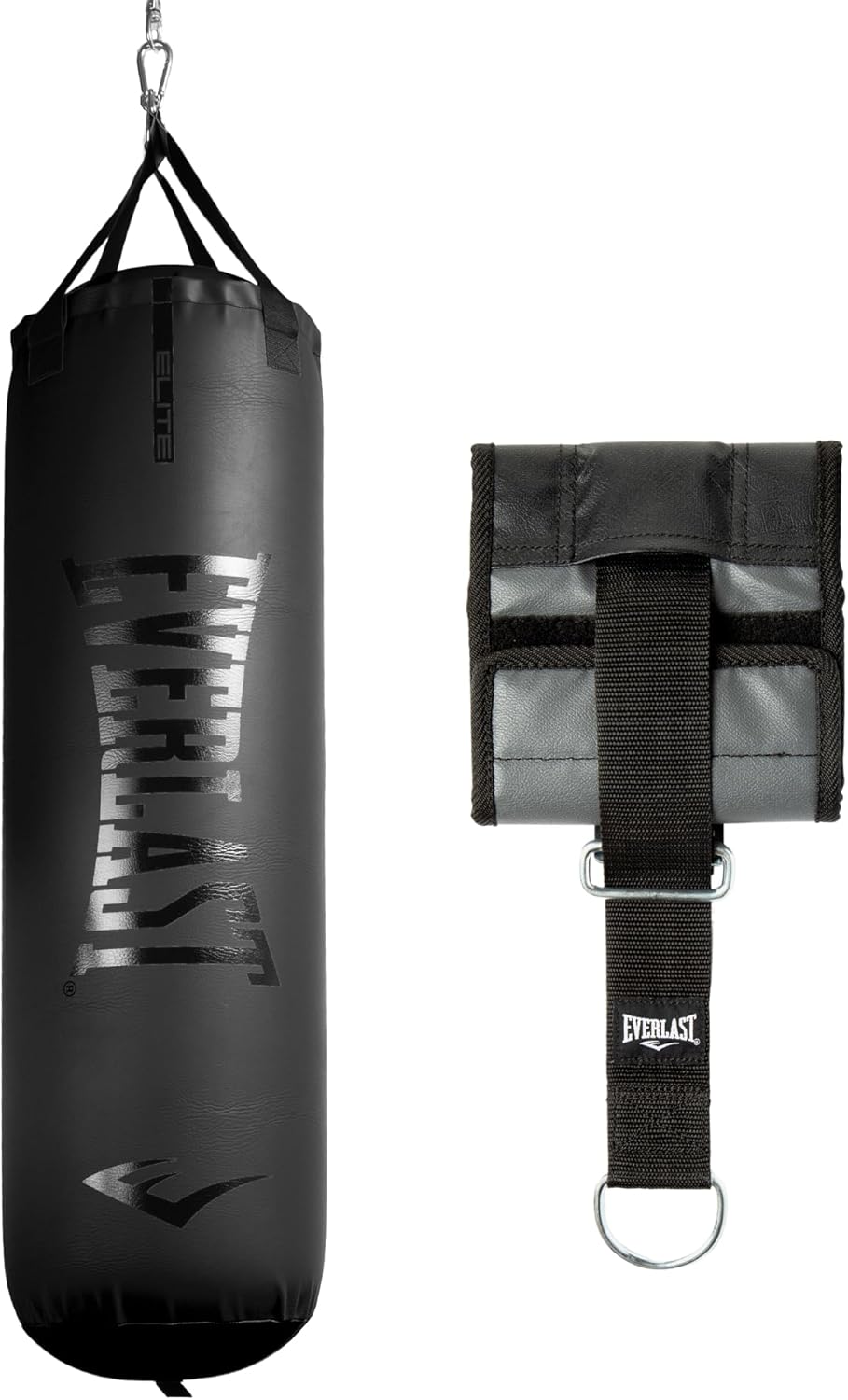 |
Everlast Elite Heavy Bag (80 lb) Best Mid-Weight |
|
The sweet spot weight for most home trainers — heavy enough to sit still, light enough to hang safely. | Check Price on Amazon |
| 04 |  |
Meister 100 lb Filled Heavy Bag Best Value |
|
Hundred-pound performance without the premium price tag. Smart buy for committed beginners. | Check Price on Amazon |
| 05 |  |
Proslayer 100 lb Filled Heavy Bag Best Premium Alternative |
|
A boutique-built bag with a satisfying, forgiving feel on the knuckles. | Check Price on Amazon |
| 06 |  |
Century Hanging Punching Bag Best Budget / Beginners |
|
No-frills workhorse. If you want to start training this month, start here. | Check Price on Amazon |
| 07 |  |
RDX Heavy 5FT Punching Bag Best Tall Hanging Bag |
|
Extra length means body shots, low kicks, and taller fighters all fit the equation. | Check Price on Amazon |
| 08 |  |
FITVEN 70″ Freestanding Punching Bag (190 lb) Best Freestanding |
|
The answer for renters and anyone without a beam to hang from. Full-height striking, zero drilling. | Check Price on Amazon |
| 09 |  |
Title Boxing Classic Heavy Bag Best Classic Gym Feel |
|
If you want the bag from the old-school gym, this is that bag. | Check Price on Amazon |
| 10 |  |
Venum Challenger Heavy Bag Best Entry-Level Brand Pick |
|
Good-looking, approachable, and ideal for lighter-to-moderate daily sessions. | Check Price on Amazon |
How to Choose the Best Heavy Bag for Home
Before you fall in love with a particular brand or a particular look on the wall, it pays to understand the four decisions that actually determine whether a heavy bag works in your house. Get these right and almost any reputable bag will serve you well. Get them wrong and even an expensive bag becomes a very heavy coat rack.
Weight: Match the Bag to Your Body, Not Your Ego
The old gym rule of thumb is straightforward — your bag should be roughly half your body weight. A 150-pound trainee gravitates toward something in the 70 to 80 pound range; a 200-pound power puncher is happier around 100 pounds. The reason is physics, not toughness. A bag that is too light for you launches across the room every time you commit to a combination, and you spend your workout chasing it instead of training. A bag that is far too heavy never moves, which quietly encourages you to over-swing and torch your shoulders and wrists.
For home use specifically, there is a second consideration: what your structure can support. A hundred-pound bag plus a heavy mounting bracket plus the dynamic load of a swinging bag puts serious force on a ceiling. If you are training in a finished room with standard drywall and joists, an 80-pound class bag is often the saner engineering decision — and honestly, for most home training, it does not limit your progress at all. If you are unsure which glove weight pairs with your bag choice, our guide to what size boxing gloves you need walks through the sizing math.
Filling: Textile, Foam, Sand, or Something Else
What is inside the bag shapes how it feels more than almost anything else. Soft textile or shredded-cloth filling gives a satisfying, slightly forgiving impact that is kind to knuckles over long sessions — many of the best home bags in this guide use exactly that approach. Foam-wrapped or layered fills tend to keep their shape and give a firmer, more consistent surface. Sand-filled cores hit back hard: great for conditioning your shins and fists, less kind to beginners, and prone to settling into a hard lump low in the bag over time.
For a first home bag, we lean toward soft textile or layered foam. Your joints will thank you during weeks three through twelve, which is precisely when most people quit.
Cover Material: What Touches Your Gloves
Heavy bags generally come in genuine leather, premium synthetic leather, or heavy vinyl-style materials such as powerhide. Real leather ages beautifully and often feels best, but it costs more and prefers a climate-controlled room. Modern synthetics have closed the gap dramatically — they wipe clean, resist humidity, and shrug off the friction of daily rounds. If your home gym is a garage that swings between hot and cold, a quality synthetic is the practical choice.
Mounting and Space: The Deal-Breaker Nobody Checks
Measure twice, seriously. A heavy bag needs room to swing without kissing a wall, and you need room to move around it in a full circle for footwork. As a practical minimum, plan for a clear training zone roughly the length of the bag plus your own height in every direction you intend to move. Ceiling height matters too — the bag should hang so its striking surface sits somewhere around your chest-to-head level.
If you rent, cannot drill, or simply do not want hardware in the ceiling, skip the hanging hardware entirely and look at freestanding designs. And if you do go the hanging route, do not improvise — our step-by-step on how to hang a heavy bag covers joists, brackets, and swivels properly.
Quick Gear Pairing Checklist
- Gloves: bag-specific gloves with dense padding — see the best boxing gloves for heavy bag training, and beginners should look at our beginner glove picks too.
- Hand wraps: non-negotiable. Start with quality hand wraps for boxing and learn how to wrap your hands before your first real session.
- Footwear: flat, grippy shoes make a visible difference in balance. Our boxing shoe guide covers what to look for.
- Warm-up: a cheap, fast jump rope for boxing is the best five-minute warm-up in the sport.
Hanging vs Freestanding: Which Home Bag Fits Your Space?
This is the fork in the road, and everything else follows from it. A hanging bag is the traditional experience: anchored above, swinging on a chain or swivel, delivering that satisfying rhythm that makes bag work feel like boxing. A freestanding bag stands on a fillable base and answers a completely different set of problems — no drilling, no beams, no landlord conversations.
The Case for Hanging Bags
Hanging bags move more naturally. That swing forces you to time your shots, cut angles, and manage distance — skills that transfer directly to sparring. They also tend to be more durable per dollar, because the entire budget goes into the bag itself rather than a weighted base system. If you own your home, have a garage or a sturdy ceiling joist, and you care about authentic feel, a hanging bag is the better long-term buy.
The trade-offs are real, though. Installation takes effort and some hardware. Hanging bags transmit noise and vibration through the structure — your downstairs family members will know your training schedule. And once it is up, it is up; moving it is a project.
The Case for Freestanding Bags
Freestanding bags are the rental-friendly option. You fill the base with water or sand, position it where you want, and start training the same afternoon. Many stand at full body height, so you can work head shots and body shots in the same round. When you move apartments, the bag moves with you.
The compromise is physics: a freestanding unit with a partially filled base will slide or tip on smooth floors under heavy power shots, and the rebound feel is different from a suspended bag. Hardcore power punchers sometimes find them less satisfying. For cardio boxing, technique work, and moderate power, they are genuinely excellent.
Category Snapshot: Four Bags, Two Philosophies
Swipe to see more →
| Style | Image | Product | Best For | Quick Take | Where to Buy |
|---|---|---|---|---|---|
| Hanging | |
Outslayer 100 lb Filled Heavy Bag | Best Overall | Dense, consistent, built to outlast your interest in quitting. | Check Price |
| Hanging | |
Ringside 100 lb Powerhide | Power Punchers | Firm response and a cover that survives heavy hitters. | Check Price |
| Hanging | |
RDX Heavy 5FT Punching Bag | Kicks & Tall Trainers | Full-length target for knees, kicks, and body work. | Check Price |
| Freestanding | |
FITVEN 70″ Freestanding (190 lb) | Renters & Flexible Spaces | Full-height striking with zero ceiling hardware. | Check Price |
Setup, Noise, and Care: The Practical Stuff
Whichever style you choose, three habits separate setups that last from setups that sag. First, protect your hands from round one — wraps under gloves, always. Second, respect the surface: wipe down synthetic covers regularly to stop salt and grit from degrading them, and treat leather occasionally so it stays supple. Your gloves deserve the same attention, and we have a full guide on how to clean boxing gloves plus a routine for breaking in new gloves without wrecking them.
Third, manage noise. A thick rubber mat under a freestanding bag kills most of the walking noise and stops the base creeping across the floor. Under a hanging bag, a quality swivel and a properly tensioned chain eliminate a surprising amount of the rattle that annoys housemates. If you train early mornings, this is not optional politeness — it is the reason you get to keep training early mornings.
Finally, keep your gear hygienic. Wraps soaked in sweat after every session will smell like a crime scene within a fortnight unless you wash them properly — here is how to wash boxing hand wraps without destroying the elastic.
Outslayer 100 lb Filled Heavy Bag
Best Overall
Ask around serious home gyms and one name keeps surfacing: Outslayer. This is the bag that convinced a lot of people you do not need a commercial gym membership to train properly. It arrives filled, hangs up, and immediately feels like equipment that expects to be hit hard for years.
What sets the Outslayer apart is the filling philosophy. Instead of sand or rubble-weight materials packed into the bottom, it uses soft textile filler distributed through the bag. The practical effect is a bag with consistent density from top to bottom — you get real feedback on a hook to the body, not a jarring thud on a hard spot and a soft mush above it. For anyone training several times a week, that consistency quietly protects your wrists and shoulders.
The outer shell is thick and unfussy, built to take the friction of heavy gloves session after session. There is nothing decorative going on here, and that is the point. This is a tool. It also carries notably generous warranty coverage relative to most of the market, which tells you something about how the manufacturer expects it to hold up.
Key Features
- Pre-filled at 100 lb — no shopping for filler material, no guessing at density
- Soft textile filling that stays even instead of settling into hard lumps
- Heavy-duty outer shell designed for daily striking friction
- Arrives ready to hang with minimal fuss
- Long-standing reputation among home and pro gym owners alike
Pros
- Dense, predictable response across the whole surface
- Forgiving on knuckles compared with sand-filled bags
- Built to last far beyond a typical home bag
- Strong warranty backing
Cons
- Full 100 lb demands serious mounting hardware
- Pricier than entry-level bags
- Overkill for casual cardio-only training
Ringside 100 lb Powerhide Heavy Bag
Best for Power Punchers
Ringside has been part of boxing’s furniture for decades, and the Powerhide line is where that heritage meets modern materials. This is a firm, serious bag for people who hit with intent — and it is one of the few that feels like it was designed by people who actually watch what happens to equipment in a busy gym.
The headline here is the powerhide cover. It is a tough synthetic built specifically to resist the scuffing, tearing, and surface breakdown that heavy gloves cause over time. Wipe it down after sessions and it stays presentable for a very long time. Underneath, the fill leans dense and firm. Where softer bags absorb your punch and give, this one pushes back — which is exactly what advanced strikers want when they are working on committing weight to their shots.
That firmness has a learning curve. Beginners sometimes find it less forgiving on the first few weeks of knuckles and wrists, and it rewards good technique over brute enthusiasm. But if you have been training a while and your current bag feels like hitting a pillow, the Powerhide will wake your hands up in the best way.
Key Features
- Powerhide synthetic cover engineered for heavy striking wear
- 100 lb class weight that stays planted under full-power combinations
- Firm, dense fill that gives honest feedback on poor technique
- From a long-established boxing equipment manufacturer
- Straightforward to clean and maintain
Pros
- Excellent durability under hard, frequent use
- Firm response ideal for power development
- Cover wipes clean easily
- Classic gym-bag feel at home
Cons
- Firm fill is demanding on unconditioned hands
- Needs robust mounting for a 100 lb swinging load
- Less forgiving for pure beginners
Everlast Elite Heavy Bag (80 lb)
Best Mid-Weight
Everlast is the name most people think of when they think of boxing at all, and the Elite line is where the brand puts its more considered home-training engineering. At 80 lb, this bag solves the most common home gym problem: how to get a heavy-bag feel without installing hardware rated for a commercial gym.
Eighty pounds is the sweet spot for a huge number of trainees. It is heavy enough to sit still through combinations from most adults, yet light enough that a well-installed mount and a normal ceiling can handle it without anxiety. The bag has a balanced swing — enough movement to teach you timing and distance, not so much that you are fighting a wrecking ball.
The Elite’s cover is a premium synthetic that feels noticeably nicer than the budget-tier vinyls you find on entry bags. It has a little texture, which gives your gloves something to bite into instead of sliding. The overall fit and finish is what you would expect from a brand with this much history: stitching is tidy, the hang points are sensible, and it looks like equipment rather than a toy.
Key Features
- 80 lb filled weight — the versatile middle ground for home use
- Premium synthetic cover with a glove-friendly surface texture
- Balanced swing characteristics for timing and combination work
- Manageable mounting requirements for standard home structures
- Backed by the most recognized name in boxing equipment
Pros
- Weight suits a wide range of body types and skill levels
- Easier on home ceilings than 100 lb bags
- Nice surface feel and tidy construction
- Excellent all-round training bag
Cons
- Heavy hitters may eventually want more mass
- Not designed for heavy low-kick work
- Premium line costs more than entry models
Meister 100 lb Filled Heavy Bag
Best Value
Meister has built a following by making home gym equipment that punches above its price, and their filled heavy bag is a textbook example. You get genuine hundred-pound class training feel without the premium-tier bill, which makes it an ideal first “real” bag for someone who has outgrown a lighter setup.
The bag comes filled and ready to work, which cannot be overstated for convenience. Filling your own bag sounds romantic until you are standing in the driveway with a funnel and three contractor bags of shredded textiles, trying to hit a density you guessed at. Meister removes that variable entirely. What you get is a bag with even, consistent resistance — solid enough for power work, forgiving enough for long conditioning rounds.
The outer shell is training-grade and built with the assumption that you will use it, not admire it. It handles the daily friction of gloves well, cleans up with a damp cloth, and does not demand leather-care rituals. For a garage gym that sees real sweat, that practicality is worth more than it sounds.
Key Features
- 100 lb class weight that stays put through committed combinations
- Pre-filled and ready to hang — no filler shopping or guesswork
- Even density throughout the bag for consistent feedback
- Low-maintenance, hard-wearing outer material
- Strong performance-to-price ratio for home training
Pros
- Genuine heavyweight feel at a friendlier price
- Consistent fill with no dead zones
- Easy to live with and maintain
- Great bridge from beginner to intermediate gear
Cons
- Still a heavy load — plan your mounting carefully
- Finish is functional rather than luxurious
- Can be more bag than light beginners need
Proslayer 100 lb Filled Heavy Bag
Best Premium Alternative
Proslayer sits in that interesting niche of specialist bag makers who focus on doing one thing extremely well. This is a hundred-pound bag built around feel — the kind of bag people describe in reviews with words like “satisfying” rather than “adequate” — and it deserves its place alongside the better-known names.
The soft compressed textile filling is the story here. Impact lands with a deep, even thud rather than a sharp crack, which changes the psychology of a session: you settle into rhythm, you throw more combinations, and your hands last longer. For anyone who trains for fitness and stress relief as much as for skill, that feel is addictive.
Construction is heavy-duty where it counts. The shell and stitching are made for daily rounds, and the bag arrives filled, so you get the maker’s intended density rather than your own approximation. It is the kind of purchase where the extra investment pays you back in feel every single session.
Key Features
- 100 lb filled weight for planted, confident power work
- Soft compressed textile filling that is gentle on joints
- Heavy-duty shell and stitching for daily use
- Arrives pre-filled to a consistent density
- Specialist bag-maker construction quality
Pros
- Exceptional impact feel — kind to knuckles and wrists
- Consistent density from top to bottom
- Serious build quality throughout
- Encourages longer, more productive sessions
Cons
- Boutique pricing versus mass-market bags
- Less brand recognition than the giants
- Soft fill is not for those wanting rock-hard conditioning
Century Hanging Punching Bag
Best Budget / Best for Beginners
Century Martial Arts has been outfitting dojos, garages, and back bedrooms for a very long time, and their hanging bags are the definition of no-nonsense. This is the bag to buy when you have decided to start — not someday, but now — and you want equipment that works without a research project attached.
There is a reason Century gear shows up in so many first home gyms: it does the fundamentals correctly at a price that does not punish you for being new. The bag has a durable outer material that stands up to daily sessions, a sensible hang, and enough weight to give you real feedback while still being manageable for a beginner learning to punch properly.
It is also a genuinely good multi-purpose bag. Boxing, kickboxing, cardio striking, basic martial arts conditioning — all of it works here. You are not paying for specialist refinements you cannot appreciate yet; you are paying for a solid target that will take everything you throw at it while your technique, fitness, and confidence come together.
Key Features
- Classic hanging design with dependable construction
- Hard-wearing outer material suited to daily home training
- Approachable size and response for new strikers
- From one of the most established names in martial arts equipment
- Versatile enough for boxing, kickboxing, and conditioning work
Pros
- Excellent entry point into real bag training
- Wallet-friendly without feeling cheap
- Durable enough to grow with you
- Great for mixed striking styles
Cons
- Lacks premium refinements of boutique bags
- Serious power punchers may outgrow it
- Basic aesthetics
RDX Heavy 5FT Punching Bag
Best Tall Hanging Bag
Most heavy bags are built for boxing — head and body height, waist to eye line. RDX goes long. At five feet, this is a full-length target, and that single dimension change opens up an entirely different training session: low kicks, knees, long body work, and realistic target zones for taller athletes.
RDX has earned its reputation the hard way, building combat sports equipment that competes on durability and value. The synthetic leather shell on this bag is tough and well-finished, and the bag’s length means you can actually practice the full striking arsenal rather than pretending the lower third of the target exists. For Muay Thai and kickboxing enthusiasts training at home, that is the whole ballgame.
The extra length also helps with shot selection and accuracy. Instead of one blob of target, you get distinct zones — head, ribs, liver, hip, thigh — which turns a mindless workout into deliberate practice. Taller boxers benefit too, since a short bag hung high ends up landing all your shots at the same awkward spot.
Key Features
- 5 ft full-length profile for head-to-thigh striking zones
- Durable synthetic leather shell built for combat sports training
- Suitable for punches, elbows, knees, and kicks
- Well suited to taller athletes and mixed striking styles
- From a widely used international combat sports brand
Pros
- Full-length target for complete striking practice
- Tough, attractive shell
- Great value in its class
- Supports kick-heavy training that short bags cannot
Cons
- Needs more vertical clearance than standard bags
- Heavier swing dynamics take getting used to
- Overkill if you only box with your hands
FITVEN 70″ Freestanding Punching Bag (190 lb)
Best Freestanding
Not everyone can hang a hundred pounds from the ceiling — and the FITVEN exists precisely for those people. At 70 inches tall with a substantial 190 lb overall figure, it delivers full-body striking without a single bolt, bracket, or joist finding. Renters, this is your bag.
The concept is clean: a tall striking column mounted on a wide base you fill with water or sand. Fill it properly and the unit sits planted through moderate-to-hard combinations; when you move house, you empty the base and roll on. The 70-inch height is the important detail here — plenty of freestanding bags stop around chest height and force you to punch downward at an angle that teaches bad habits. This one stands at a real striking height, so your posture and shot trajectory stay honest.
Freestanding bags do come with physics-based caveats. On smooth floors, a lightly filled base will creep or tip during full-power work — put down a rubber mat and fill the base properly and most of that disappears. The rebound feel is different from a hanging bag too: less swing, more dead-stop absorption. For boxing fitness, technique drilling, and cardio rounds, it is genuinely excellent. For hardcore power development, a hung 100 lb bag still has the edge.
Key Features
- 70″ striking height for realistic head and body shot placement
- 190 lb overall figure for stability when properly filled
- Fillable base — no drilling, no ceiling mount, no landlord issues
- Relocatable: empty it and move it where you need it
- Full-body training target for punches, knees, and kicks
Pros
- Zero installation — training the day it arrives
- True-to-life striking height
- Perfect for apartments, rentals, and shared spaces
- Easy to reposition or store
Cons
- Needs a filled base and a mat to stay truly planted
- Rebound feel differs from a traditional hanging bag
- Base filling adds setup effort and floor weight
Title Boxing Classic Heavy Bag
Best Classic Gym Feel
Some bags are engineered around features. The Title Boxing Classic is engineered around a feeling — the one you get walking into a real boxing gym and hitting a bag that has been there for fifteen years. Traditional, dependable, and completely uninterested in trends.
Title Boxing lives and breathes the sport, and that focus shows in the details. The Classic has the traditional filled-bag character that experienced boxers recognize instantly: a measured amount of give, a satisfying rebound as the bag swings, and a surface that breaks in rather than breaks down. It is the bag that teaches you rhythm. After a few weeks on it, you start to understand shot timing on a level that static equipment never delivers.
As a long-term ownership proposition, the appeal is durability through simplicity. There are no gimmicks to fail and no clever systems to maintain. Just a well-made bag with a dependable outer shell that does its job for years. It is also an excellent choice for anyone who trains across styles — pure boxing, fitness boxing, and general striking all feel right here.
Key Features
- Traditional filled heavy bag construction with classic rebound
- Dependable outer shell built for sustained training
- Authentic boxing gym feel and response
- From a brand dedicated specifically to boxing
- Simple, proven design with nothing to fuss over
Pros
- Wonderful rhythm and rebound for combination work
- Long-term durability through proven design
- Great feel for developing proper shot timing
- Boxing-heritage brand credibility
Cons
- Traditional bags can develop settle points over many years
- Plain looks compared to modern designs
- Requires proper hanging hardware like any quality bag
Venum Challenger Heavy Bag
Best Entry-Level Brand Pick
Venum built its name on fight-night aesthetics and combat sports credibility, and the Challenger line brings that within reach of the home trainer. This is the bag for people who want gear that looks the part, performs honestly, and does not require a second mortgage.
The Challenger is positioned as the accessible end of the range, and it delivers exactly what that should mean: solid construction, a clean synthetic exterior, and a response suited to the way most people actually train at home — regular sessions focused on fitness, technique, and stress relief rather than professional fight camps. The surface has a sleek finish that wipes down easily, and the bag holds its shape well through consistent moderate use.
What you are also buying into is an ecosystem. If you start with Venum gloves, wraps, and shorts, the Challenger keeps everything visually coherent — which sounds superficial until you realize that liking the look of your setup is one of the underrated reasons people actually keep showing up.
Key Features
- Accessible entry point to a respected combat sports brand
- Clean, durable synthetic exterior that is easy to maintain
- Well-scaled response for home fitness and technique training
- Matches the broader Venum gear ecosystem
- Approachable price for brand-name equipment
Pros
- Brand-name quality at an entry-level price
- Looks excellent in a home setup
- Easy to clean and maintain
- Good weight and response for daily cardio boxing
Cons
- Not built for elite-level power training
- Entry line lacks premium refinements
- Lighter users will enjoy it most
Heavy Bag FAQs for Home Training
Everything people ask us before pulling the trigger on a home heavy bag — answered without the marketing gloss.
What weight heavy bag should I buy for home use?
The classic guideline is a bag around half your body weight. Under 150 pounds, look at the 70 to 80 pound class. Between 150 and 190, both 80 and 100 pound bags work depending on how hard you hit. Above that, the 100 pound bags in this guide are the natural fit. Beyond body weight, consider your ceiling: an 80 pound bag is far easier to hang safely in a standard finished room than a hundred-pounder.
Is a 100 lb heavy bag too heavy for a beginner?
Not necessarily, but it is not automatically the right choice either. A 100 lb bag will not hurt you by being heavy — it will simply sit there and force you to generate your own force, which is actually good for building proper mechanics. The real issue is mounting and space. If you are a lighter beginner in a rented room, an 80 pound class bag or a freestanding unit is the smarter, safer start.
Can I hang a heavy bag in an apartment?
Possibly, but think carefully. Hanging a heavy bag requires a structural joist or beam rated for dynamic load — not drywall, not a decorative ceiling. In most apartments, the better answer is a freestanding bag on a rubber mat, which protects the floor and dramatically reduces transmitted noise. If you do own your space and have exposed beams, our guide on how to hang a heavy bag covers the safe way to do it.
Which is better for home use: a hanging bag or a freestanding bag?
It depends entirely on your constraints. Hanging bags swing more naturally, last longer per dollar, and feel more like real boxing training — choose one if you own your home and have the structure for it. Freestanding bags win on convenience: no drilling, easy relocation, and a full-height target. For most renters and casual-to-intermediate trainers, freestanding is the practical winner. For committed boxers with a garage, hanging is the better long-term tool.
Do I need gloves and wraps to hit a heavy bag?
Yes, and this is not optional hand-holding. Bare-knuckle bag work is a fast track to scuffed skin, wrist strain, and injuries that stop your training for weeks. Wraps stabilize the small bones of the hand and wrist; gloves add impact protection. Start with quality hand wraps and learn how to wrap hands for boxing properly. If you are unsure about glove sizing, our guide on what size boxing gloves you need covers the maths.
How much space do I need for a heavy bag at home?
More than most people expect. You want a clear circle of movement around the bag — ideally a radius equal to the bag’s length plus your own height so you can work angles in every direction. At absolute minimum, you need enough room to circle the bag without punching a wall and enough ceiling height for the bag to hang at chest-to-head striking level. A single-car garage corner or a cleared spare room usually works well.
How do I keep my heavy bag and gloves in good condition?
Wipe the bag’s cover down after sessions to remove sweat and grit, and let it air dry. Wash your wraps after every use or two — here is exactly how to wash boxing hand wraps without wrecking the elastic. Gloves need attention too: our guide on cleaning boxing gloves and our routine for breaking in new gloves will keep your kit hygienic and lasting far longer.
Will heavy bag training help me lose weight?
It is one of the most efficient conditioning workouts you can do. A few rounds of real bag work elevates your heart rate quickly, builds lean muscle through repeated bracing and rotation, and burns meaningful calories in a short session. It also happens to be genuinely fun, which matters more than any calorie table — the best exercise is the one you will actually repeat. We cover the details in our guide on whether boxing helps you lose weight.
What is the difference between sand-filled and textile-filled bags?
Sand-filled bags are hard and heavy-hitting — great for conditioning your shins and fists, but tough on joints and prone to settling into a hard lump near the bottom over time. Textile or shredded-cloth filling gives a softer, more even impact across the whole bag, which is why most of our top picks for home use use it. Foam-layered bags sit somewhere in between with a firmer, consistent surface. For a first home bag, textile or foam filling is the friendlier choice.
Can southpaws and orthodox fighters use the same heavy bag?
Absolutely. A heavy bag is stance-agnostic — it is a target, not a partner. What matters is that you train your own stance and angles deliberately. If you are curious about the differences between the two stances and how they change your bag work, our comparison of southpaw vs orthodox boxing breaks it down clearly.
How long does a heavy bag last?
A quality bag used several times a week should give you many years of service. The usual failure points are the cover surface wearing through from friction, the fill settling unevenly, and the hanging hardware fatiguing. You can extend all of these: wipe the cover, rotate or fluff the bag occasionally, and inspect your chains, swivel, and mounts regularly. Buying from a reputable maker — like every bag in this guide — is the single biggest factor in longevity.
What else do I need for a complete home boxing setup?
Bag, gloves, wraps, and space are the core. From there, most people add a jump rope for warm-ups — our pick of the best jump ropes for boxing covers it — plus flat, stable shoes (see our boxing shoes guide, and no, wrestling shoes are not the same thing). If you plan to spar eventually, add headgear and a mouthguard. Curious about the sport’s structure? Our explainer on boxing weight classes is a good read, and if you have ever watched a fight and wondered about the scoring, here are the boxing decisions explained.
The Bottom Line: Which Heavy Bag Should You Buy?
Ten bags, one question — and the honest answer is that the “best” one depends on your walls, your ceiling, and your ambition. But if you want a straight recommendation, here it is.
For most people building a serious home gym, the Outslayer 100 lb Filled Heavy Bag is the one to buy. It is dense without being brutal, consistent from top to bottom, built to survive years of real training, and backed in a way that suggests the manufacturer agrees. It is the bag you buy once.
If your ceiling or your budget pushes back, the Everlast Elite at 80 lb is the sweet spot for the majority of home trainers — enough weight to train properly, light enough to hang without engineering anxiety. Value hunters should look hard at the Meister 100 lb, which delivers hundred-pound class feel at a friendlier price. And if you rent, cannot drill, or simply want flexibility, the FITVEN 70″ Freestanding solves the problem elegantly without sacrificing striking height.
Whichever you choose, do the small things right from day one: wrap your hands, wear proper gloves, warm up, and give the bag room to swing. Those habits matter more to your progress than any spec sheet ever will.
You May Also Like
More from our boxing training and gear guides to round out your home setup.
Best Boxing Headgear
What to look for in head protection when sparring moves from the bag to a partner.
Best Mouthguards for Boxing
The small piece of kit that makes a far bigger difference than its size suggests.
Boxing Weight Classes
From strawweight to heavyweight — how the divisions work and why they exist.
Boxing Decisions Explained
Unanimous, split, majority, draw — what the judges’ cards actually mean.
Wrestling Shoes vs Boxing Shoes
They look similar in the aisle. In the ring, they are very different tools.
How to Wash Hand Wraps
Keep your wraps fresh and elastic without turning laundry day into a disaster.